收听文章:
一览
- 1.An SOP describes, step by step, how a process is carried out correctly — ISO 9001, IATF 16949, GxP and other norms mandate them.
- 2.SOP, work instruction, procedural instruction and operating instruction describe similar but not identical documents depending on the industry.
- 3.Traditional creation in Word takes 4–8 hours per SOP. AI-driven methods such as Video-to-SOP cut this to roughly 10 minutes.
Standard Operating Procedures are not optional in industry — they are a legal requirement. What makes an SOP, which norms demand them, and how they are built.
An SOP (Standard Operating Procedure) is a written work instruction that describes how a specific process is carried out correctly, step by step. In manufacturing, pharma, hospitals and food production, SOPs are not optional — they are a legal requirement and are checked at every audit.
Why SOPs are essential in industry
Every manufacturer faces the same problem: critical process knowledge lives only in the heads of experienced employees. When a foreman with 30 years of experience retires, he takes thousands of hand movements and decision rules with him — irretrievably. SOPs preserve this knowledge in a standardized, retrievable form.
At the same time, standards like ISO 9001, ISO 45001, IATF 16949, GxP (pharma), HACCP (food) and the EU MDR (medical devices) demand documented work instructions for every relevant process. If they are missing at an audit, you risk losing your certification, a production stop, or being delisted by your OEM.
SOP, work instruction, procedural instruction — what is the difference?

In practice these terms are often used interchangeably, but there are subtle differences:
SOP (Standard Operating Procedure) is the most widely used international term, especially in pharma, chemicals and global companies. It describes the standardized flow of a process.
The work instruction (WI) is the most common German-industry term — manufacturing, mechanical engineering, steel. It focuses on the operational execution at the workplace.
The procedural instruction (PI) is mainly used in hospitals, medical devices and ISO 9001 quality systems. It describes higher-level flows (who does what, when).
The operating instruction is specific to the chemicals industry (GefStoffV §14 in Germany) and governs the safe handling of hazardous substances and installations.
Structure of a good industrial SOP

The heart of any SOP is the step-by-step instruction with images. Every work step is described clearly and illustrated with a picture from the actual process.
On top come safety notes and protective measures: PPE requirements, precautions before starting the process, and colour-coded critical steps.
Quality control (OK / Not-OK) with comparison images shows the target state and common defects — the section auditors appreciate most.
Beyond that: tool lists, escalation plans, machine-specific notes, a process overview. The more complete, the more audit-proof.
How long does it take to create an SOP?
The traditional method — observe, photograph, write in Word, review, release — takes on average 4 to 8 hours per SOP according to industry experience. See our detailed comparison of the five most common methods in the article Creating work instructions: 5 methods compared.
Which standards require SOPs?
ISO 9001 (Section 7.5) requires documented procedures for quality-relevant processes. ISO 45001 (Clause 8.1) requires SOPs for safety-critical activities. IATF 16949 (Clause 8.5.1.2) explicitly requires visual work instructions. GxP and FDA 21 CFR Part 211 require SOPs for every manufacturing process. HACCP, IFS Food and BRC require documented hygiene procedures. EU MDR 2017/745 along with SEVESO III and GefStoffV §14 round out the picture.
Creating SOPs with AI
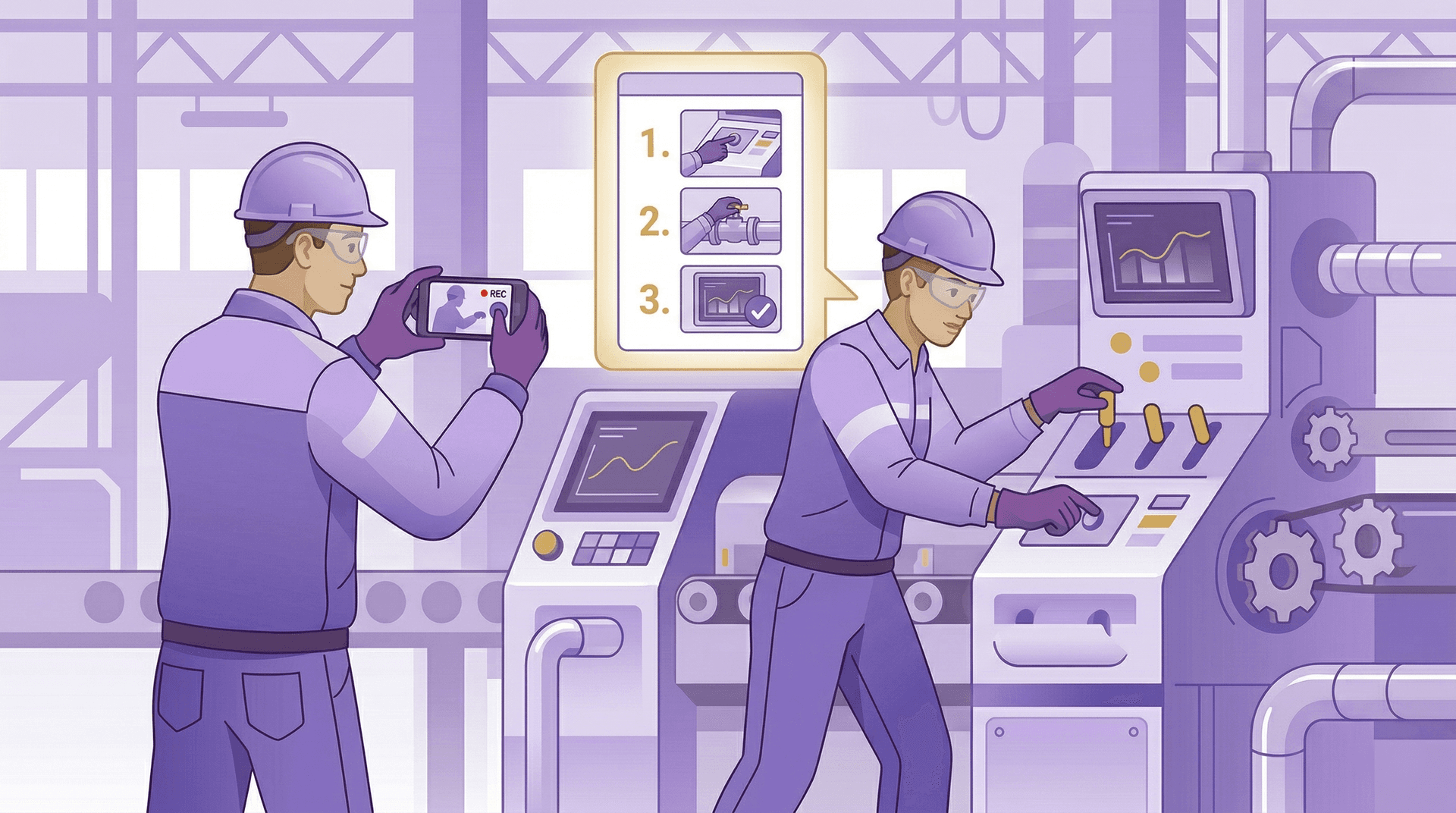
AI-driven approaches like Video-to-SOP enable a fundamentally different workflow: the most experienced operator demonstrates the process while a colleague films and narrates (five minutes). An AI analyses video and audio and automatically generates a structured SOP with images, safety notes and quality checks. Faces are anonymized automatically. Soperion delivers this workflow for the manufacturing industry.
The method is particularly useful for sectors with high turnover, shift work and multilingual teams — anywhere manual SOP creation can no longer keep up with the documentation demand.
常见问题
- How much does it cost to create an SOP?
- Traditionally: 4 to 8 hours of staff time per SOP (industry experience value). With AI-driven Video-to-SOP tools the effort drops to about 10 minutes.
- How often must SOPs be updated?
- Typically every 12–24 months or whenever the process changes. With Video-to-SOP updating is as fast as the initial creation.
- What happens if SOPs are missing at an audit?
- Depending on the standard: a finding, loss of certification, supplier delisting (automotive), a Warning Letter (FDA/pharma) or a production stop.
- Can AI really turn complex industrial processes into SOPs?
- Yes. The AI transcribes and structures what the experienced operator shows. Domain expertise stays with the human — who reviews and releases the final document.