Ascultă articolul:
Pe scurt
- 1.IATF 16949 clause 8.5.1.2 requires visual work instructions accessible at the workplace — not in a QM folder on SharePoint.
- 2.The most common audit findings: work instructions are 3–8 years old, contain no images, are not available at the workplace, and changes are not traceable.
- 3.The e-mobility transition makes it worse: battery cell production, high-voltage assembly, and e-motor winding are brand-new processes with no existing documentation.
- 4.OEMs like BMW, VW, Mercedes, and Stellantis increasingly demand digital availability at the workplace. QR-code-based work instructions are becoming the standard.
IATF 16949 is the strictest quality standard in manufacturing. Clause 8.5.1.2 requires visual work instructions at the workplace — most suppliers fail at least one requirement.
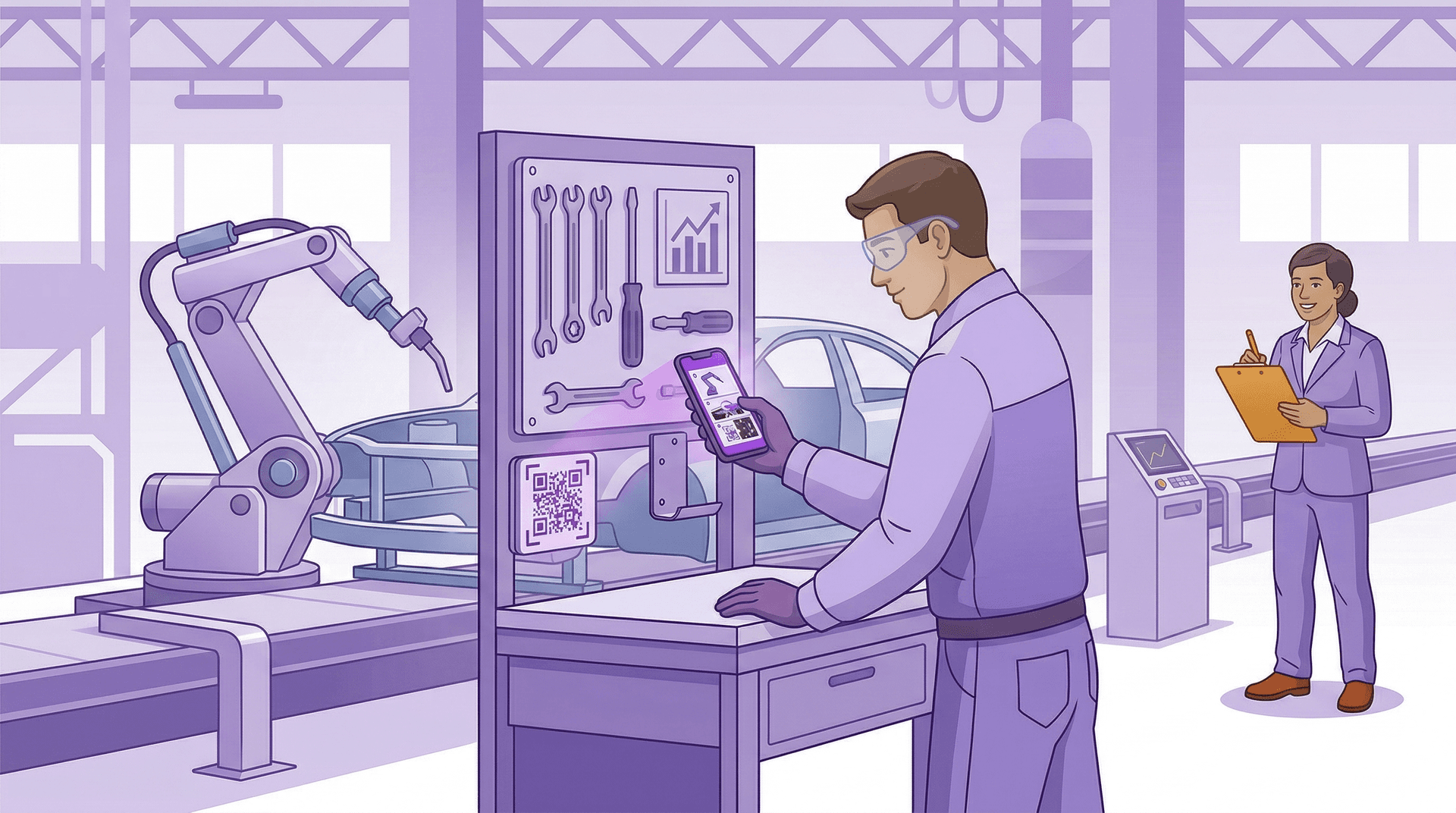
IATF 16949 is the strictest quality standard in the manufacturing industry. Clause 8.5.1.2 explicitly requires documented work instructions for every employee responsible for product quality — and these must be accessible at the workplace, not in the office on SharePoint. A process video becomes a visual work instruction with images, quality checks, and QR code access directly on the production line.
What IATF 16949 clause 8.5.1.2 actually requires

The standard places five core requirements on work instructions: they must exist for every relevant process. They must be accessible at the workplace — not in the office, not on a network drive, but right where the operator works. They must enable the operator to run the process correctly. They must contain visual standards — images, not just text. And they must be updated promptly when the process changes.
In practice most automotive suppliers fail on at least one of these points. The most common audit findings: work instructions are 3–8 years old and never updated, contain no visual standards, are not available at the workplace, and changes are not traceably documented. These findings lead to major non-conformities — in the worst case, loss of the IATF certificate and with it the OEM contracts.
How Video-to-SOP fulfills IATF 8.5.1.2 automatically
Every single requirement of clause 8.5.1.2 is addressed directly. Visual standards are produced automatically — every step has an image from the real process, no stock photos, no technical drawings. Access at the workplace is via QR code right at the machine — the operator scans with a smartphone and sees the current instruction.
The revision history documents every change with timestamp, author, and approval record — exactly what the IATF auditor wants to see during document review. On top of that, the quality-control feature (OK/Not OK with reference images) supports in-process inspection requirements: the operator sees directly what a correctly assembled part looks like and what typical defects look like.
E-mobility: thousands of new SOPs with no existing documentation
The e-mobility transition makes the problem worse: battery cell production, high-voltage assembly, e-motor winding, and thermal management systems are brand-new processes. No supplier moving from combustion to EV has existing work instructions for the new processes. They have to be created from scratch — in parallel with the production ramp-up.
Video-to-SOP makes it possible to document in parallel with line start-up: while the setter runs in the new line, they film the processes, and the SOPs are ready before the first series operator shows up at the line. A decisive time advantage in the most critical phase.
Why OEMs demand visual SOPs
BMW, VW, Mercedes, and Stellantis regularly assess their suppliers. The question "show me your work instruction for process X" is standard at every supplier audit. Increasingly, OEMs demand not just existence but digital availability at the workplace. QR-code-based visual work instructions will become the standard over the coming years. Suppliers that adopt this early position themselves as preferred partners.
Întrebări frecvente
- Are Word SOPs enough for IATF 16949?
- The standard does not mandate a format, but Word SOPs without visual standards lose points in supplier assessments. Digital, QR-code-based instructions with real process images meet the requirements better.
- How many SOPs does an automotive supplier need?
- A mid-sized supplier with 50 assembly stations typically needs 50–200 work instructions. With traditional methods that takes 6–18 months. With Video-to-SOP: days to weeks.
- What if the OEM demands a specific SOP format?
- Work instructions can be exported as PDF and via REST API to any required format. The internal structure can be adapted to customer-specific needs.
- How do you win over the QA manager?
- Clause 8.5.1.2 requires visual standards at the workplace. Video-to-SOP fulfills that automatically — with real images from the process instead of Word text. Any QA manager immediately sees the value compared to the current state.