लेख सुनें:
एक नज़र में
- 1.By 2030, 35 to 40 percent of the industrial workforce in Germany will leave their companies -- thousands of manual skills and experience values that exist nowhere on paper.
- 2.Classic methods fail: tacit knowledge cannot be written into Word documents, six months are not enough for 40 years of experience, and nobody reads a 200-page knowledge dump.
- 3.Video-to-SOP solves all three problems at once: the expert shows instead of writes, needs five minutes instead of months, and produces a visual procedure anyone understands immediately.
- 4.One week produces 15 to 25 complete procedures -- one month preserves the entire critical knowledge of a department digitally.
Why 35 to 40 percent of the industrial workforce will leave by 2030, why classic methods fail, and how Video-to-SOP captures process knowledge in days instead of years.
By 2030, 35 to 40 percent of the industrial workforce in Germany will leave their companies -- through retirement, early retirement, or career change. What they take with them: thousands of manual techniques, decision rules, and experience values that exist nowhere on paper. This tacit knowledge is the most valuable asset of any industrial company -- and it is disappearing irrecoverably. Video-to-SOP technology is the fastest way to preserve this knowledge before it is too late.
The scale of the problem

A blast furnace master with 40 years of experience knows instinctively when the slag has the right consistency. A maintenance expert hears from the sound of a pump whether a bearing is worn. A setter knows 50 different machine types and their quirks -- which screw must not be over-tightened, which valve must be opened first on start-up, which error message can be ignored. This knowledge lives only in their heads.
The economic cost of knowledge loss is enormous: longer onboarding times for successors (three months instead of two weeks), higher scrap rates (because the new operator does not know the subtleties), more machine downtime (because fault diagnosis takes longer), more frequent quality issues, and in the worst case workplace accidents because critical safety knowledge is lost.
Why classic methods fail
The typical approach is: we sit the experienced employee down six months before retirement so they can write down their knowledge. This fails for three fundamental reasons.
First, tacit knowledge is hard to verbalize. The master does not know what they know -- much of it runs automatically. When asked how they judge the slag, they say: you just see it. This knowledge cannot be captured in a Word document.
Second, there is no time. Six months are not enough to document 40 years of experience systematically. And during those six months the master still has their regular job.
Third, nobody reads the result. A 200-page knowledge document will never be read by any successor -- and even if it were, text cannot convey the nuances of physical processes.
The solution: Video-to-SOP

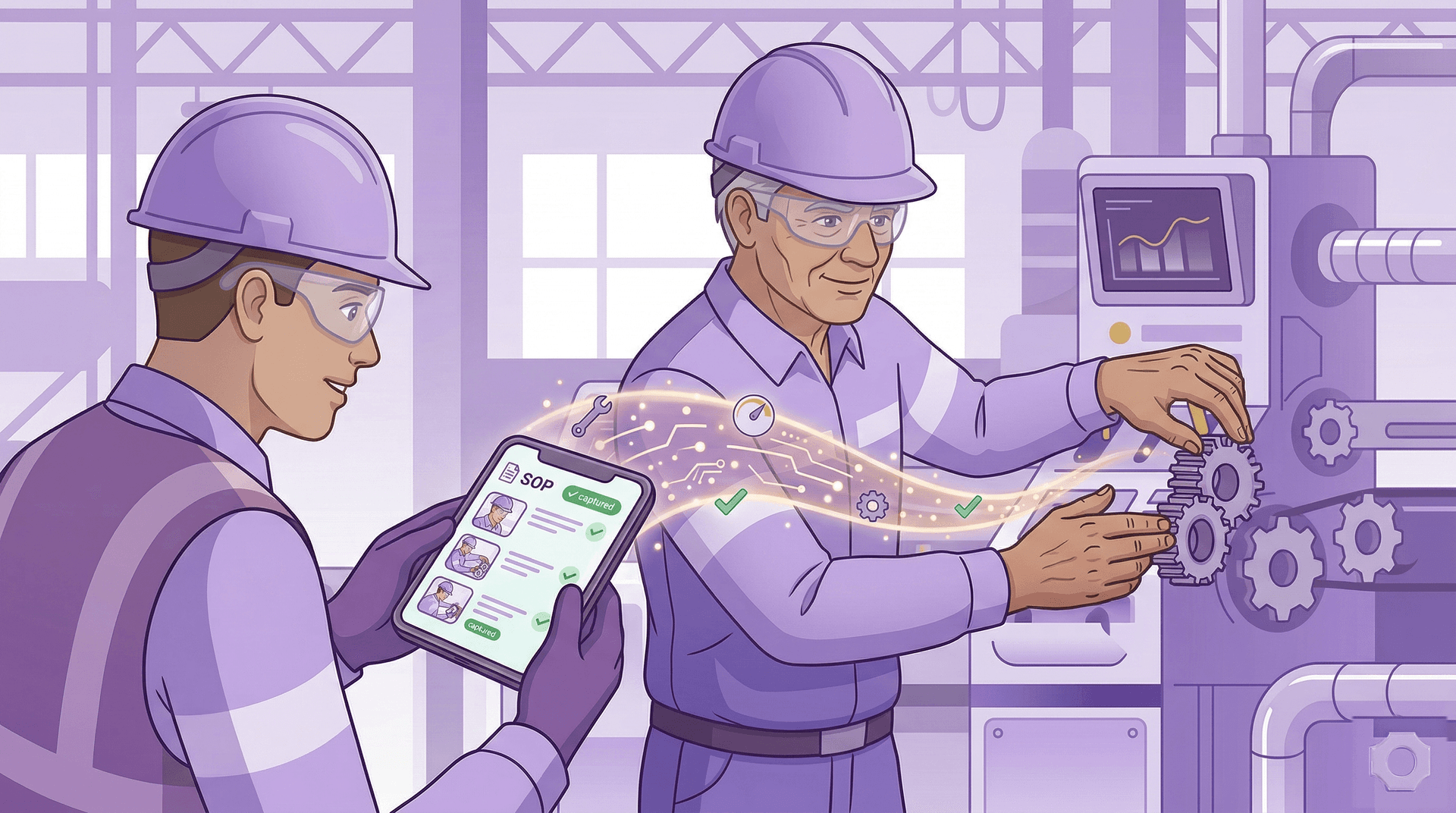
Video-to-SOP solves all three problems at once. Instead of writing down their knowledge, the expert shows the process -- and the AI transcribes and structures the knowledge automatically. Instead of months, they need five minutes per process. And instead of an unread 200-page document, the result is a visual, structured work procedure with images anyone understands immediately.
It is possible to preserve the knowledge of an experienced employee in one week: they record three to five of their most important processes per day. One week produces 15 to 25 complete procedures. One month preserves the entire critical knowledge of a department digitally -- for the successor, the journeyman, the apprentice, and for all future employees.
A FTSE-250 industrial group already runs Soperion in more than a dozen plants -- exactly for this purpose: knowledge retention ahead of the retirement wave.
अक्सर पूछे जाने वाले प्रश्न
- How much knowledge can be captured per day?
- An experienced employee can record 10 to 15 processes per day. In one week: 50 to 75 SOPs. In one month: the entire critical knowledge of a department. The effect multiplies as more employees are involved.
- Does the experienced employee need to be technically savvy?
- No. They only need a smartphone and the ability to explain their process while performing it. No tripod, no script, no post-production.
- What if the employee has already retired?
- Then the knowledge is unfortunately lost -- which is why acting now is so urgent. For employees who will retire within the next one to three years, Video-to-SOP is the last chance to preserve their knowledge.
- How does Video-to-SOP differ from classic knowledge management?
- Classic methods rely on interviews and Word documents -- they take months and fail on tacit knowledge. Video-to-SOP captures the process directly in action: five minutes of recording instead of six months of documentation.