Écouter l'article :
En un coup d'œil
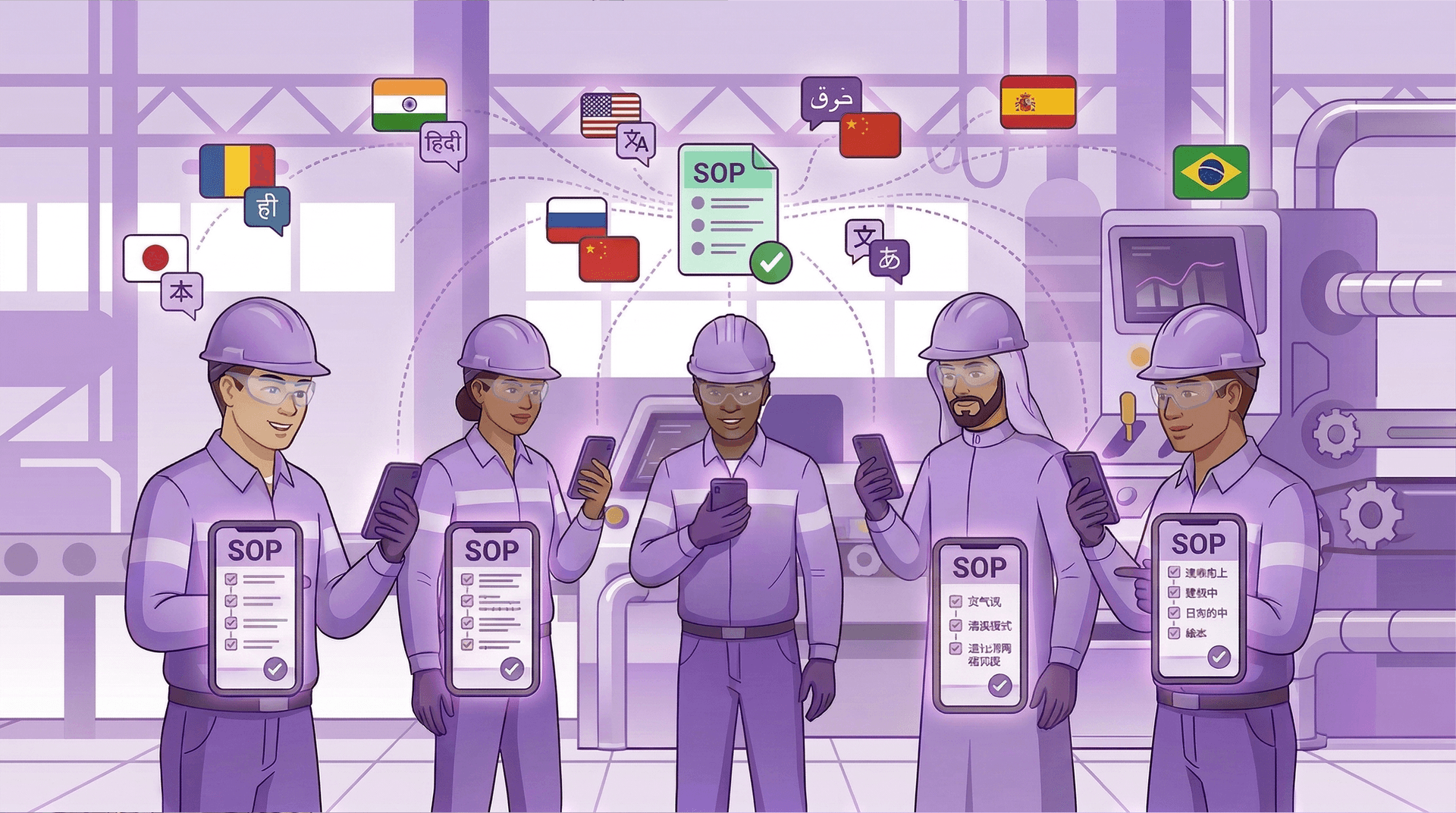
- 1.Industrial plants run teams from 10 to 25 nationalities. Written instructions in one language reach almost none of them.
- 2.Visual SOPs built from real process footage are understandable independent of language — even for workers who can't read.
- 3.Automatic translation into each worker's native language adds a native-text layer on top of the visual layer.
A typical industrial plant has teams from 10 to 15 nationalities. A German-only Word document reaches almost none of them. Visual SOPs solve the language problem.
A typical industrial plant has teams from 10 to 15 nationalities. A logistics center during peak season has 25 or more. A fast-food restaurant has 20. A single-language Word document sitting in the shift supervisor's office reaches almost none of those workers. The solution: visual SOPs that work independent of language — and, going forward, automatic translation into every worker's native language.
The language problem on the shop floor

Multilingual workforces are not the exception — they are the rule. In food processing, more than half the workforce often doesn't speak the local language fluently. In facility management and building cleaning, teams pull from 30+ nationalities — Arabic, Tigrinya, Farsi, Vietnamese, Romanian, Bulgarian.
The result: written instructions in the local language sit unread in the supervisor's office. Everyone does it the way the colleague showed them — a colleague who may have been on the job for only two months themselves. The consequences are inconsistent process flows, hygiene gaps, quality problems, and in the worst case, accidents.
The dual approach: visual and multilingual
Soperion solves the language problem on two layers at once. The first layer is visual SOPs with step-by-step images from the real process. Images are universally understandable — regardless of language. An image showing how a fryer is cleaned needs no translation. Color-coded safety markings (red for danger) work without a single word.
The second layer is automatic translation into many languages, currently in development. With it, every SOP becomes available in the worker's native language — the Polish worker sees Polish, the Turkish worker sees Turkish, the Arabic-speaking worker sees Arabic. The images stay identical; only the text is translated.
Which industries benefit most?
The industries with the most multilingual teams are facility management and building cleaning with 30+ nationalities, quick-service restaurants and fast food with extreme turnover, logistics and warehousing especially during peak season, hotels and hospitality, food processing with seasonal labor, and construction with subcontractors from 15+ countries on every large site. In all these industries, visual multilingual SOPs are not nice-to-have — they are the only way to enforce standards.
Questions fréquentes
- Which languages are currently supported?
- Soperion currently supports multiple European languages. Automatic translation into many additional languages is in development.
- Do visual SOPs also work for workers who can't read?
- Yes — the step-by-step images and color markings communicate the process purely visually. It works even for workers with no reading ability.
- How is terminology accuracy ensured during translation?
- Automatic translation is trained on industry-specific vocabulary. In addition, customers can provide their own glossaries.